10 August 2026
Keeping shrimp through an Australian winter

It is late winter and the tanks have gone quiet: less grazing, no berried females (females carrying eggs), food still on the dish next morning. Almost none of that is a problem. Winter losses come less from cold water than from water that changes temperature quickly, usually a bucket of cold tap water.
Shrimp run at whatever temperature the water is
Neocaridina davidi and the Caridina we keep are ectotherms (cold-blooded), so metabolic rate follows the water. Within their normal range, a 10 °C drop cuts invertebrate metabolic rate to roughly a half to a third, though that ratio comes from general invertebrate physiology rather than any measurement in dwarf shrimp. Appetite goes with it, growth slows, and since a shrimp only grows by moulting (shedding its shell to make room), moults become less frequent. A colony at 16 °C doing very little is not sick, it is idling.
On names: tigers are usually placed in Caridina mariae, crystal red and crystal black more often in Caridina logemanni than Caridina cantonensis, though shop labels still use C. cantonensis for the whole bee group. Bee-shrimp taxonomy is unsettled and applied inconsistently between sources. Nothing below turns on the label.
Cold water holds more dissolved oxygen, so oxygen is not the winter worry. Nitrifying microbes (the helpful bacteria that process waste) also slow, so a cold tank clears ammonia more slowly and a cycle started in a cold room can stall; running a heater at 22 to 24 °C for the duration is part of How to cycle a tank for shrimp. Winter is a poor season to add many animals at once.
What an unheated tank actually sits at
The tank tracks the room, with a lag set by volume. In an unheated room in Melbourne, Canberra or Hobart, an August night indoors can land anywhere from single figures to the mid teens, though indoor lows vary so much between houses that any one range means little. A 20 L nano ends the night close to the room and warms again by day, so it can swing several degrees in 24 hours; 100 L moves far less. In Brisbane the same tank often sits in the high teens all winter without help.
Do not take my numbers for your house. A min/max thermometer gives you the overnight low and the daily range, which is what to plan around.
| Water temperature | What you will see |
|---|---|
| Below about 12 °C | Barely moving, not feeding, no moults. A fault to fix, not a season to sit out |
| 12 to 16 °C | Neocaridina slow but alive, breeding stopped, bee-type Caridina under real stress |
| 16 to 20 °C | Grazing continues, growth slow, few berried females. Where many unheated Neocaridina sit |
| 20 to 24 °C | Normal activity, moulting and breeding continue. The usual year-round target |
Those boundaries are hobby consensus, not published limits. If you find a tank at the bottom of the table, warm it back gradually rather than in one step; around 1 °C per hour is the pace most keepers settle on, with no measured figure behind it.
Should you heat at all?
Opinion is genuinely divided. One camp runs Neocaridina unheated all year, reasoning that a cool winter is closer to the seasonal swing these shrimp meet in the wild, and that a slower metabolism may go with a longer life. The other heats year-round for continuous breeding and insurance against a cold snap.
Less contentious: Neocaridina davidi handles cool water better than the bee-type Caridina, and stability matters more than the number. Neocaridina are commonly kept from 18 to 28 °C, with 20 to 24 °C the sensible target, though those outer bounds are hobby convention rather than measured limits; the rest of the numbers are in Neocaridina water parameters. A tank steady at 18 °C is easier to live in than one reading 17 °C at dawn and 24 °C by evening. As a working rule rather than a measured threshold, heat if you keep Caridina, or if your daily range runs to several degrees. Often the better fix is not a heater: warm the room, move the tank off an external wall, fit a lid, and run a larger volume.
Heaters: sizing, placement, and the failures that cook a colony
The rule of thumb is roughly 1 W per litre to hold about 5 °C above room temperature. So a 20 L tank wants about 20 W: the smallest heater on the shelf, usually 25 W, not the 50 W often sold alongside it. An oversized heater in a small tank is the dangerous combination, because when the thermostat sticks closed the water heats fast enough that you find out too late.
Placement does most of the remaining work:
- Submerged past the minimum immersion mark, rechecked as evaporation drops the level, and switched off at the wall before a water change drops it further.
- In moving water, near the filter outflow or a sponge riser, so heat is carried rather than pooling.
- Low and horizontal, since warmed water rises.
- Not in substrate, not against the glass, not behind hardscape where a shrimp can wedge in.
The failures worth planning for:
- Thermostat sticks closed. The heater never switches off, the classic way to lose a colony overnight.
- Calibration drift. Preset heaters can sit several degrees from the number printed on them, though that is keeper report rather than a tested spec.
- Power path. The heater shares a switched board with the lights and goes off nightly with them, producing the swing you were trying to remove.
Two cheap habits cover most of this: trust an independent thermometer over the dial, and run the heater through an external controller with its own probe. Controllers fail too, so the thermometer stays.
Cold tap water is the shock worth eliminating
Melbourne tap water in August is genuinely cold, in the region of 10 to 14 °C, though supply temperature varies with suburb and season. Do the arithmetic on a routine change: swap 30 per cent of a 22 °C tank for 12 °C water and you land at 19 °C, a 3 °C drop in the time it takes to pour.
- Treat it for chlorine and chloramine (a longer-lasting form of chlorine) with a conditioner first. Standing water overnight is for temperature, not dechlorination (removing the chlorine), and does not reliably deal with chloramine. Which of the two your supply zone uses is worth checking with your water authority rather than assuming.
- Bring it within about 1 °C of the tank, a spare heater in the bucket being the tidy method, and read both with the same thermometer.
Sudden shifts in temperature or chemistry are widely blamed for triggering moults at the wrong point, which is how a shrimp that looked fine dies two days after a water change. That link is hobby observation rather than a demonstrated mechanism. The rest of the water-change routine, from mixing ahead to how much to change at once, is in Shrimp moulting problems and the white ring of death.
Feeding and breeding both wind down
A cold colony eats a fraction of what it does in summer, and the surplus rots in a tank whose microbes are also slow. Halve what you offer and judge by what is left on the dish; the detail is in Feeding shrimp: what, how much, and how often.
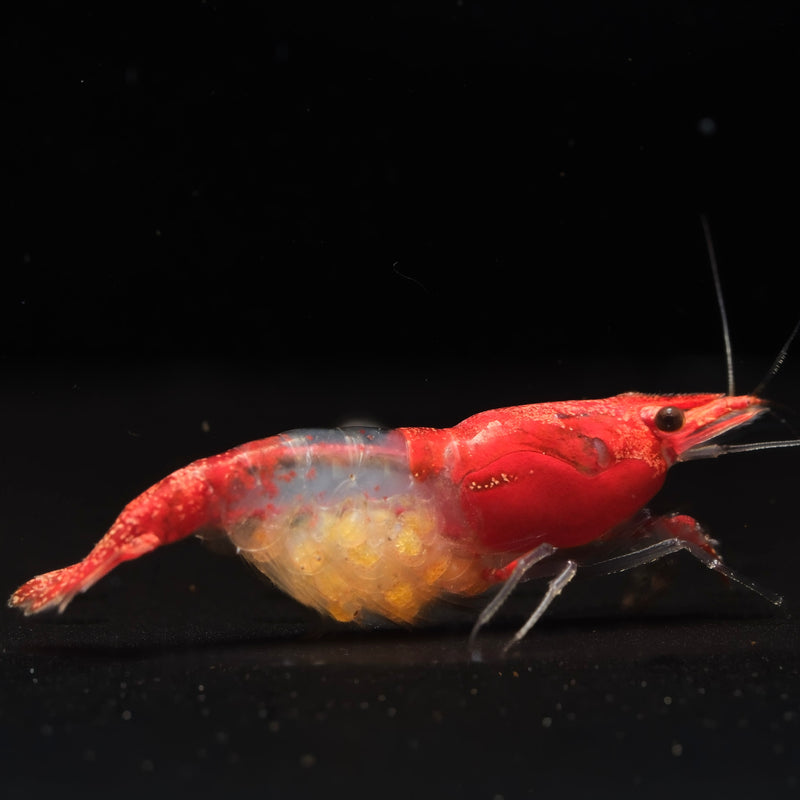
Berried females become uncommon in an unheated tank over winter, and in a cold room they disappear. Eggs already carried take longer to develop, since embryonic development is temperature dependent, though how much longer at a given temperature is not something anyone has pinned down for Neocaridina davidi. Things restart in spring, often quite suddenly, as the water climbs back through the low twenties, which is the season to act on Breeding Neocaridina: how to start a colony. For shrimplets through winter, heat the tank and keep it steady; a marginal heater in a cold room only produces a bigger swing.
Taking delivery of shrimp in winter
Livestock ships Mondays and Tuesdays. In winter the receiving end matters more than usual.
- Have the tank ready before the box arrives: cycled, stable, already at the temperature you intend to keep. Do not raise the heater on the day.
- Be home, and open the box straight away, indoors and out of direct sun.
- Photograph and film first. Our Live Arrival Guarantee needs a claim within 8 hours of delivery, with photos and a short video of the animals in the unopened bag; the remedy is replacement or refund of the livestock value, your choice. Details are in the DOA and missing items policy.
- Acclimatise slowly, into stable water. The bag will be cooler than a heated tank, so temperature and chemistry are both moving at once; the method is in How to acclimatise your new shrimp.
We ship unsexed juveniles (young, not yet sexable) at 0.6 to 1.2 cm, so stable water matters more to them than water sitting at exactly 24 °C.
Winter keeping comes down to one habit: know your overnight low, and never let the water move faster than the shrimp can.