10 August 2026
Breeding Neocaridina: how to get a colony going

The short version: start with at least ten juveniles of one colour strain, put them in a fully cycled tank you are willing to leave alone, hold it at 20-24 °C, feed lightly, and wait about three months. Neocaridina davidi breed without encouragement once conditions are stable. In our experience, colonies that never take off stall because the keeper kept intervening.
Colony maths: why ten is the floor
Ten is a probability problem, not a superstition. Shrimp Zone ships unsexed juveniles at 0.6–1.2 cm, and at that size nobody can sex them reliably, including us.
Assuming a roughly even sex ratio and independent draws, the chance of a single-sex group is about 1 in 8 at four shrimp, about 1 in 32 at six and about 1 in 500 at ten. Add early attrition, and ten is the sensible minimum; fifteen to twenty is better.
- One colour strain per tank. All Neocaridina davidi colour morphs (colour variants) interbreed freely, so a mixed-colour tank drifts back to wild-type brown and clear within a few generations. Neocaridina and Caridina do not cross, and Neocaridina versus Caridina covers what that split means in practice.
- Refine the line yourself. Once the colony is established, keep the best-looking shrimp as the next generation’s parents and move the rest on. That is how we produce our stock at Shrimp Zone — selecting the strongest colour and pattern each generation — and it works in a home tank just the same. A colony bred from its best animals gets better every year.
Sexing adults
Differences become readable at roughly 1.5 cm, commonly eight to ten weeks after arrival, though this shifts with temperature and feeding. Judge a group side by side against a plain background, not one shrimp alone.
| Feature | Female | Male |
|---|---|---|
| Adult size | About 2.5-3 cm | About 2-2.5 cm |
| Underside | Deep and curved, a skirt over the swimmerets (the small paddling legs under the tail) | Straighter and slimmer, no skirt |
| Colour | Usually denser, more opaque | Often thinner, patchier, more translucent |
| Saddle | Present once mature | Absent |
Saddled versus berried
A saddle is the developing ovaries seen as an opaque patch through the carapace just behind the head, commonly cream, yellow or greenish depending on strain. It means a female is getting ready, not that anything has been fertilised.
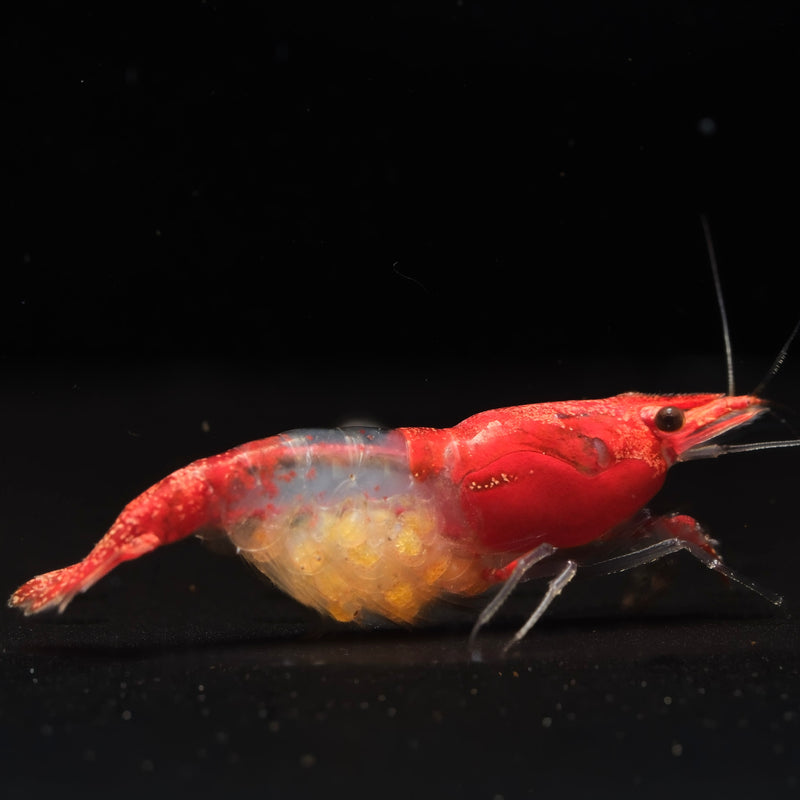
A berried female carries fertilised eggs under her abdomen in the swimmerets, fanning them constantly to keep them oxygenated. The sequence: saddle develops, female moults, mating follows within a few hours of that moult, eggs pass down to the swimmerets. A saddle that vanishes with no berries means the mating did not happen or the clutch was lost.
What actually triggers breeding
| Parameter | Target | Note |
|---|---|---|
| Temperature | 20-24 °C | Commonly kept about 18-28 °C, though the outer bounds aren't well established; breeding slows markedly below about 20 °C |
| pH | 6.8-7.8 | Stability matters more than the exact figure |
| GH | 6-10 dGH | Calcium and magnesium for moulting |
| KH | 2-6 dKH | — |
| TDS | 150-250 ppm | Our Neocaridina are raised in remineralised Melbourne tap water, input TDS about 60, dosed to about 160 |
| Ammonia and nitrite | 0 ppm | Non-negotiable |
| Nitrate | Under 20 ppm | Climbing nitrate means overfeeding, overstocking, or changes too small or too rare |
The reasoning behind each figure, the KH argument included, belongs to the Neocaridina water parameters guide. It is late winter here, so the risk in most rooms is cold, not heat: an unheated tank in a Melbourne lounge room can sit anywhere from single figures to the mid teens through the night, which is survivable but stalls breeding, and colonies commonly pause until spring. Use a thermostatically controlled heater checked against a separate thermometer; keeping shrimp through an Australian winter covers the rest. Livestock ships Mondays and Tuesdays, and cold-month arrivals want a slow acclimatisation.
Biofilm (the thin film of microbes shrimp graze) is the quiet driver: a tank run for a couple of months with mature substrate, moss and a few botanicals (dried leaves and cones) feeds shrimp continuously, which is the condition females breed in.
Incubation and clutch size
Expect roughly 25-35 days from berried to hatch in the 20-24 °C band, shorter when warmer and longer when cooler. Three weeks at 26 °C to five weeks at 20 °C is hobby consensus rather than a controlled figure. A first clutch is often small, perhaps 10-20 eggs; mature females more commonly carry 20-30, sometimes more. The eggs darken as they develop and show two black eye dots each in the last week. Many females re-berry within days of releasing a clutch, which is why colony numbers jump suddenly. First-time mothers sometimes drop a clutch for no visible reason; one dropped clutch is not a diagnosis.
Water changes and berried females
This is the most common own goal. Moulting is tied to the shrimp's osmotic environment (the mineral balance it holds against the water), and a sudden shift in TDS, GH or temperature can trigger an unscheduled moult. That's widely accepted in the hobby, though the thresholds aren't well quantified. A berried female who moults sheds the exoskeleton (shell) with the swimmerets attached, and the clutch goes with it. More on that in shrimp moulting problems and the white ring of death.
- Keep changes small, 10-15% at most, and slow; pour against the glass rather than dumping it in.
- Match new water on temperature (within about 1 °C) and TDS before it goes in. Mix and measure in a bucket; never dose remineraliser into the tank.
- Top up evaporation with RO or distilled, not remineralised water: evaporation leaves the minerals behind, so mineralised top-ups walk your TDS upward. Dechlorinated tap adds a little too.
- Leave the berried female where she is. Netting her into a "safe" tank is more likely to make her drop the clutch than protect it.
Keepers disagree on cadence: a small weekly change on principle, or top-ups only in heavily planted, lightly stocked tanks. Both produce thriving colonies; what they share is that the water never lurches.
Raising shrimplets
Neocaridina hatch as fully formed miniatures about 2 mm long, with no larval stage and no brackish (part-salt water) phase, unlike Amano shrimp (Caridina multidentata), whose larvae will not survive in fresh water. Shrimplets stay hidden for the first few days and graze biofilm off whatever they land on.
- Sponge filter, or a pre-filter on any intake. A bare canister or hang-on-back (external filter types) will take shrimplets.
- Moss and botanicals. Java or Christmas moss gives grazing surface and cover, and catappa leaves, alder cones and dried oak leaves break down into the biofilm they eat. More options in best plants for a shrimp tank.
- Feed lightly. Surplus food feeds hydra, which do catch shrimplets, and flatworms. Most flatworms hobbyists call "planaria" are harmless rhabdocoels (a smaller, harmless flatworm) rather than the predatory kind, though that's hobby consensus.
- Do not deep-clean. Skim debris rather than driving a gravel vacuum through the substrate.
- Watch the tankmates. Almost any fish that can fit a 2 mm shrimplet in its mouth will eat one, rasboras and tetras included. Otocinclus and most snails are generally regarded as safe; a species-only tank gives much better survival. Which fish are safe with dwarf shrimp works through the compromises.
A realistic timeline
Counting from arrival, at 20-24 °C; a cooler tank stretches every step. These are commonly reported timings, not a schedule.
- Week 0. Ten or more unsexed juveniles at 0.6–1.2 cm go in. Acclimatise slowly. If something is wrong on arrival, the Live Arrival Guarantee runs on a claim within 8 hours of delivery with photos and a short video of the animals in the unopened bag, and the remedy is replacement or refund of livestock value, your choice (DOA and Missing Items Policy).
- Weeks 1-8. Growth. Resist the urge to change things.
- Weeks 8-12. First saddles, then the first berried female.
- Months 3-4. First shrimplets, usually unseen for a week after hatching.
- Months 5-8. The first tank-bred generation breeds and the colony becomes self-sustaining.
Where keepers disagree
Culling (removing off-type shrimp from the line) for colour is standard for anyone maintaining a line and distasteful to plenty of home keepers; both positions are defensible. Running warm at about 26 °C is widely said to speed breeding and shorten lifespan, with cooler tanks doing the reverse; there is no consensus on which trade is better, and the temperature-to-lifespan link is inferred from metabolic rate rather than measured.
Neocaridina are the forgiving option and the right place to learn. Caridina, meaning the crystal and bee lines (Caridina logemanni and Caridina cantonensis) and the tigers (Caridina mariae), breed on similar principles but want softer, more acidic water and leave less room for error.
Neocaridina to start a colony with
- Bloody Mary shrimp: deep, solid red cherry shrimp
- Blue Dream (Sapphire Blue) shrimp: solid deep-blue Neocaridina
- Green Emerald (Green Jade) shrimp: dark green Neocaridina
- Ultra Gold (Yellow Golden Back) shrimp: solid gold with a back stripe
- Red Rili shrimp: red head and tail, clear middle
- Demon Bloody Mary shrimp: orange-eye Bloody Mary
- Ghost Yellow (golden eye) shrimp: golden-eye Neocaridina
Our bulk discounts step up at 10 and 20 shrimp, the group sizes this guide recommends.