9 August 2026
Neocaridina vs Caridina — which should you start with?

Nearly every question we get from someone about to buy their first shrimp is really this question underneath. Here is the honest version.
The short answer
Start with Neocaridina. Not because Caridina are difficult animals — they are not, once the water is right — but because Neocaridina let you learn shrimp keeping and water chemistry one at a time instead of both at once. Most people who keep Caridina well started with Neocaridina.
What actually separates them
These are two different genera — separate species groups, like two branches of a family tree — not two colours of the same shrimp. Almost all the colourful Neocaridina in the hobby — Bloody Mary, Snowball, the blues, Green Emerald, the Rili patterns — are colour lines of Neocaridina davidi. Crystal Red and Crystal Black, the King Kongs, Pandas, Blue Bolts and the whole Taiwan Bee family are lines of Caridina cantonensis.
That has a practical consequence worth knowing before you buy: the two genera do not interbreed. Within a genus it is a different story. Different Neocaridina colour lines cross readily, and their offspring drift back towards wild-type brown over a few generations; Caridina lines cross with each other just as happily. One colour line per tank is the rule that keeps a colony looking like what you paid for.
Water: the real difference
| Neocaridina | Caridina (incl. Taiwan Bee) | |
|---|---|---|
| Source water | Dechlorinated tap water | RO water, rebuilt from scratch |
| TDS | roughly 150–250 ppm | roughly 100–150 ppm |
| GH | roughly 6–10 | roughly 4–6 |
| KH | roughly 2–6 | 0–1 |
| pH | roughly 6.8–7.8 | roughly 5.5–6.5 |
| Substrate | Anything inert | Active, buffering soil |
Treat those as working ranges rather than targets — what matters far more is landing somewhere sensible and then staying there. Reading the table: TDS is total dissolved solids (everything dissolved in the water), GH is general hardness (its mineral content), KH is carbonate hardness (what steadies pH), pH below 7 is acidic; the substrate is the tank-floor material — inert means it leaves the water alone, while an active soil deliberately pulls pH down; RO is purified reverse-osmosis water.
That table is the whole beginner story. Our Neocaridina are raised in tap water run through a three-stage filter for chlorine and sediment (no RO membrane), then dosed with shrimp minerals to around TDS 160 — which is why they transition into an ordinary established community tank so smoothly. Caridina ask you to strip water back to nothing with an RO (reverse-osmosis) unit and rebuild it with a GH-only remineraliser (a mineral mix that adds hardness without KH), over an active soil that pulls the pH down and holds KH near zero. None of that is hard. It is simply a second hobby running alongside the first, with its own kit and its own weekly routine.
Hardiness and margin for error
Neocaridina are not indestructible — no shrimp is — but they have more room for your mistakes. They tolerate a wider band of GH, KH and pH, and they shrug off the small day-to-day drift that every home aquarium has. Caridina live in a narrower band, and the same drift shows up faster: failed moults (moulting is shedding the shell to grow), a colony that stops breeding, losses that arrive a fortnight after the cause.
Two things neither genus forgives: copper (check every fish medication, plant fertiliser and snail treatment before it goes near a shrimp tank) and rapid change. Both genera are far more sensitive to how fast a parameter moves than to where it lands.
Temperament
Peaceful in both cases. Both are grazers that spend the day working over biofilm (the thin film of microbes on every wet surface) on plants, wood and hardscape; neither eats healthy plants, and neither will bother tank mates. The difference is confidence rather than aggression — Neocaridina tend to be out in the open more of the time, while a good few Caridina lines are more retiring, especially as juveniles and for the first week or two after arriving.
Cost
Per shrimp, Neocaridina are the most affordable livestock we sell. Caridina lines sit higher, and the scarcer mutations — the orange-eye lines in particular — higher again. Current prices are on the Neocaridina and Caridina collections.
The bigger cost difference is not the animals, though. It is the kit. Caridina realistically mean an RO unit, a GH-only remineraliser, a TDS pen, GH and KH test kits, and active soil that will need replacing eventually. Neocaridina need a dechlorinator and, depending on your supply, a remineraliser.
One note on grades if you do go straight to Caridina: Entry is our most accessible grade and Collector our highest, and grading describes appearance only — never health. An Entry shrimp is the same lineage and the same hardiness as a Collector shrimp, with less of the pattern that is difficult to breed for. It is the sensible tier to learn on.
Breeding
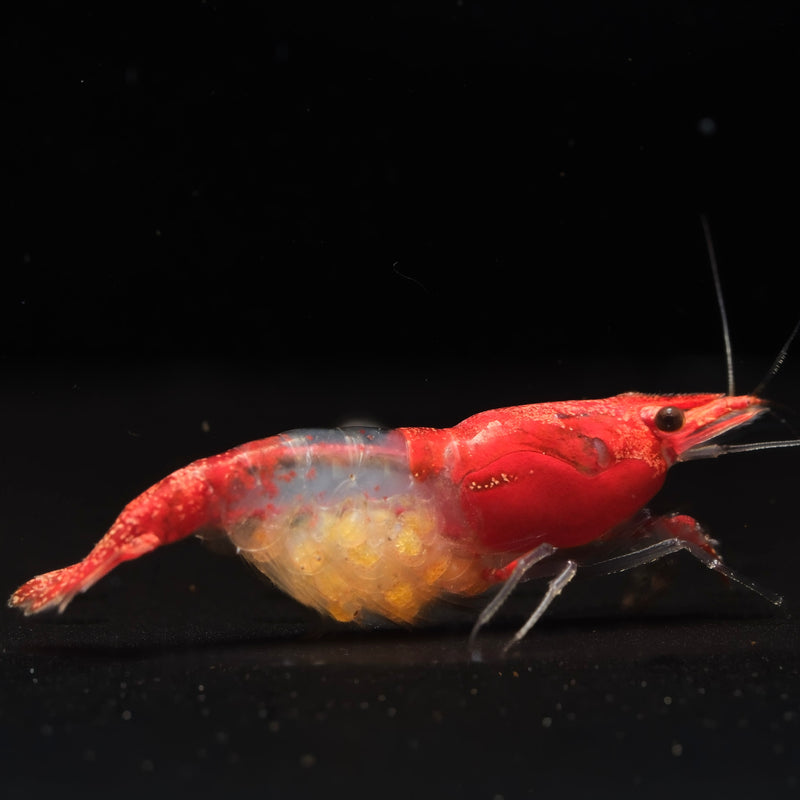
Both genera are direct developers: eggs hatch into miniature versions of the adults. No larval stage, no brackish water, nothing special required. A berried female carries her eggs beneath her tail for roughly a month before they hatch.
In practice, Neocaridina breed in a stable, mature tank almost without your involvement — the usual outcome of doing nothing wrong is more shrimp. Caridina breed just as readily once their water is right and stays right; they are simply less tolerant of the tank drifting while you are not looking. The difference is not fertility, it is how much of your attention the tank asks for.
So which should you start with?
Neocaridina, plainly. Pick one colour line you actually like, start with a group of ten or more so the colony has numbers to work with, and give it a few months. We ship unsexed juveniles (young shrimp, too small to tell male from female yet) at 0.6–1.2 cm, which is the size that adapts best to your water — a group of that size gives you a fair shot at both sexes.
Once that tank has been quietly breeding for a season and you have a feel for what your water does between water changes, a Caridina tank is a genuinely enjoyable next step rather than an expensive gamble. Plenty of people run both side by side.
Whichever way you go, read the Shrimp Care & Acclimation Guide before your first order arrives, and browse the Taiwan Bee lines when you are ready for them. Not sure what your tap water is doing? Send us your GH, KH and TDS and we will tell you honestly which genus your water already suits.
Examples of each
Neocaridina:
- Bloody Mary shrimp: deep, solid red cherry shrimp
- Blue Dream (Sapphire Blue) shrimp: solid deep-blue Neocaridina
- Green Emerald (Green Jade) shrimp: dark green Neocaridina
Caridina:
- Pure Red Line (PRL) shrimp: red Taiwan bee line
- Galaxy Boa shrimp: metallic blue-green with a white hood
- Black Galaxy Fishbone shrimp: fishbone-patterned galaxy
For something different again, Sulawesi shrimp such as the Cardinal Sulawesi shrimp need warm, hard, alkaline water unlike either group above.
Browse all Neocaridina or all Caridina.