10 August 2026
Water parameters for Caridina and Taiwan Bee shrimp

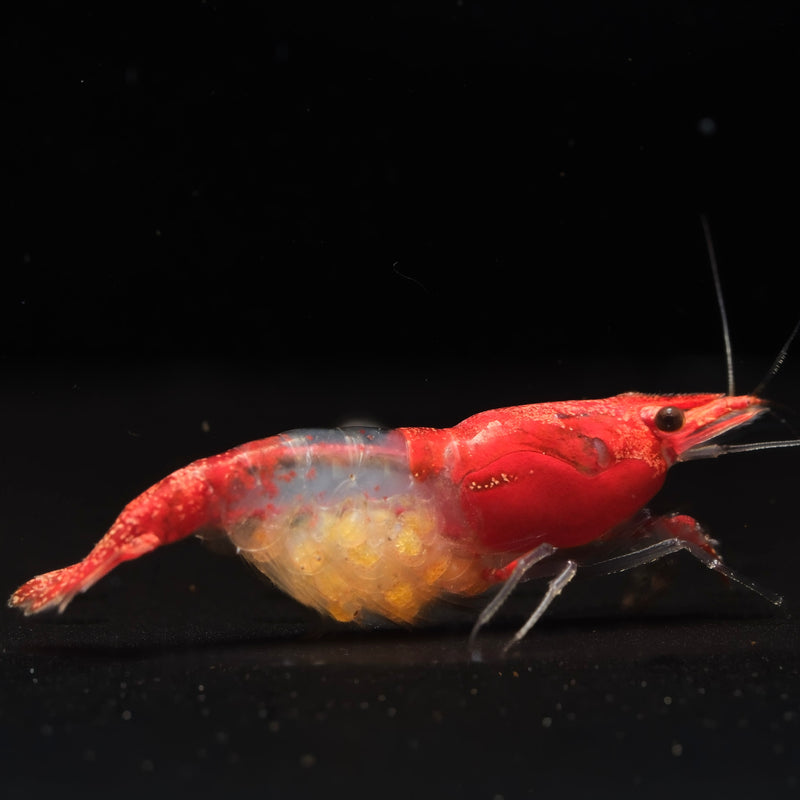
Crystal shrimp, King Kongs, Pandas, Blue Bolts and the rest of the Taiwan Bee family are all lines of Caridina cantonensis, and they all want the same thing: soft, low-mineral, gently acidic water that does not move. Here is what that means in numbers, and — more usefully — what to do when the numbers drift.
The working ranges
| Parameter | Working range | Notes |
|---|---|---|
| TDS | roughly 100–150 ppm | The single most useful number to check often. A TDS pen costs little and tells you most of what you need. |
| GH | roughly 4–6 | From a GH-only remineraliser. This is the mineral content that drives moulting. |
| KH | 0–1 | Near zero is correct here, not a fault to be fixed. |
| pH | roughly 5.5–6.5 | Produced by the substrate, not by dosing chemicals. |
| Temperature | roughly 20–24 °C | Steady matters more than exact. Warmer water speeds everything up and holds less oxygen. |
| Ammonia & nitrite | 0 | Non-negotiable, always. |
| Nitrate | low | Kept down by small, regular water changes rather than big occasional ones. |
First, the labels: TDS is total dissolved solids — everything dissolved in the water; GH is general hardness, its dissolved mineral content; KH is carbonate hardness (explained below); pH below 7 is acidic. Read those as ranges, not as targets. A colony sitting steadily at TDS 140 will do better than one you keep nudging towards 120 every weekend.
Copper. Whatever your parameters, keep copper out. Check fish medications, snail treatments and plant fertilisers before anything goes near a Caridina tank.
Why KH sits at zero
This is the bit that catches people coming from fishkeeping, where KH is treated as a safety net. In a Caridina tank it is the opposite. Carbonate hardness is what resists a pH drop — so if you add KH, you are fighting the active substrate that is meant to be pulling the pH down into the mid-6s. The result is a tug of war: the soil exhausts faster, the pH wanders, and you have paid for a buffering substrate only to have it work against you.
So: GH yes, KH no. The remineraliser you want raises general hardness only. A GH/KH+ product — the right choice for Neocaridina — is the wrong one here, and mixing the two up is one of the most common reasons a first Caridina tank never quite settles.
Building the water
The routine is simple once it is a habit.
- Start with RO water (RO is reverse osmosis — a purifier that strips tap water back to almost nothing) — near enough to zero TDS. Tap water carries minerals you cannot remove selectively, so you strip it back and rebuild.
- Add a GH-only remineraliser to your target, mixing in a separate container and letting it dissolve fully. Dose by TDS reading, and confirm with a GH test rather than trusting the dose chart alone.
- Match the temperature before it goes anywhere near the tank.
- Change small and often. Weekly changes of around 10–15% keep nitrate down without shifting anything sharply.
- Top up evaporation with plain RO, no minerals. Evaporation removes water and leaves the minerals behind — topping up with remineralised water is the slow, invisible way TDS climbs over a month.
The substrate does half the work
An active (buffering) soil is not decoration in a Caridina tank — it is the equipment holding your pH where it needs to be. It also means the tank has a lifespan built into it: that buffering capacity is used up gradually, and no substrate does it forever.
You will see it coming in the test kit rather than in the shrimp. KH creeping above zero, and pH climbing towards neutral where it used to sit in the mid-6s, is the substrate telling you it is running out. Plan the replacement rather than being surprised by it — and when you do it, do it in stages if you can, because replacing the whole bed at once changes every parameter in the tank on the same afternoon.
Temperature, honestly
Caridina do well in the low 20s. Warmer water is not instantly harmful, but it raises their metabolism, speeds growth and breeding, and holds less dissolved oxygen — which leaves less margin when something else goes wrong. In an Australian summer the practical problem is usually the swing between a hot afternoon and a cool night rather than the peak itself. A tank in a cooler room, out of direct sun, with decent surface movement, does more for a colony than chasing a specific figure.
What to test, and how often
- TDS — whenever you think of it, and always before a water change. It is your early-warning system.
- GH and KH — weekly drop tests. Slow enough to matter, cheap enough to bother with.
- pH — weekly. Watch the trend, not the individual reading.
- Ammonia and nitrite — every few days on a new tank, then occasionally on an established one, and any time something looks wrong.
Write the readings down. A single number tells you almost nothing; six weeks of numbers tells you what your tank actually does.
Stability beats perfection
If there is one thing to take from all this: shrimp handle a slightly-off, steady tank far better than a textbook-perfect one that swings. Losses in a Caridina tank are more often caused by a fast correction than by the original problem. If a parameter has drifted, walk it back over days rather than in one water change — and if you are adding new shrimp to water that differs from ours, drip them in slowly, as set out in our Shrimp Care & Acclimation Guide.
Every line in the Caridina range lives happily in the water described above. If your numbers sit somewhere different and you are not sure whether to adjust or leave well alone, email us your GH, KH and TDS — we keep these shrimp ourselves, and we will give you a straight answer for your tank rather than a generic one.
Caridina lines that want this water
- Pure Red Line (PRL) shrimp: red Taiwan bee line
- Galaxy Boa shrimp: metallic blue-green with a white hood
- Black Galaxy Fishbone shrimp: fishbone-patterned galaxy
- Blue Steel shrimp: orange-based blue steel
- Black Devil shrimp: orange-eye black King Kong
- Red Devil shrimp: orange-eye dark red King Kong
- Hornet galaxy tiger shrimp: orange-based galaxy black tiger
- Red Wasp galaxy tiger shrimp: pink-based galaxy red tiger
Browse all Caridina and Taiwan bee shrimp.