Photos
Videos
Red Rilli
$12.00
In stock
Juveniles are young shrimp — they travel best at this size, and many strains only show their full colour as they mature. After display-ready adults? Contact us.
Save 15% on 20+ · auto in cart
Pay in full · save 5%
Buying several, or after a particular grade?
Make an offer
You’ve already made an offer on this one
We take one offer per item per day, and yours is already with us — we read every offer ourselves and reply by email, usually within a business day. You can send a new offer on this item tomorrow. Need to add or change something now? WhatsApp us and mention your offer.
Pre-order — this line is between batches. Order now and we'll ship when the next batch is ready. Most pre-orders ship sooner — 21 days is the longest you'd wait.
Sold out — check back after the next batch, or use the notify tab for a back-in-stock email.
Description
Red Rili Shrimp (Neocaridina) | Single Grade Colony
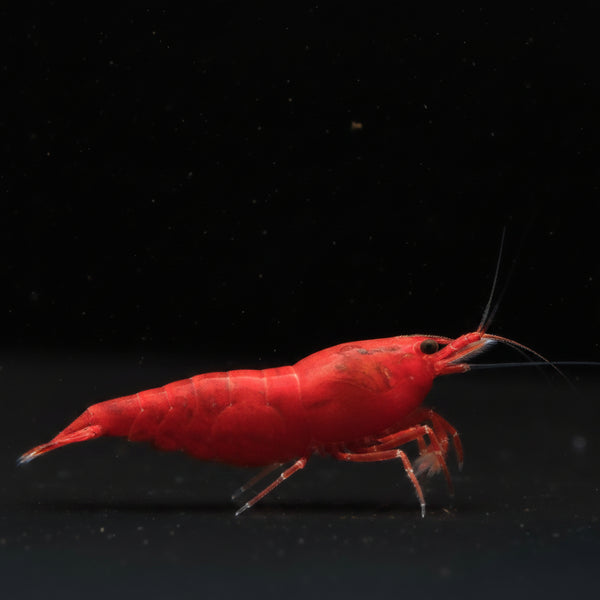
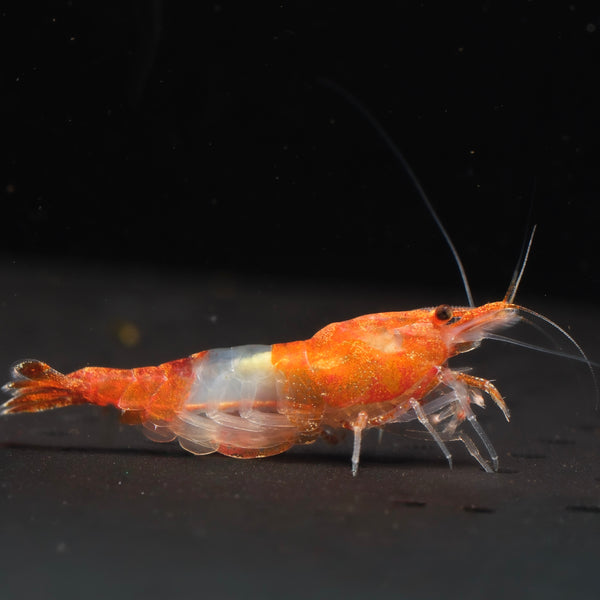
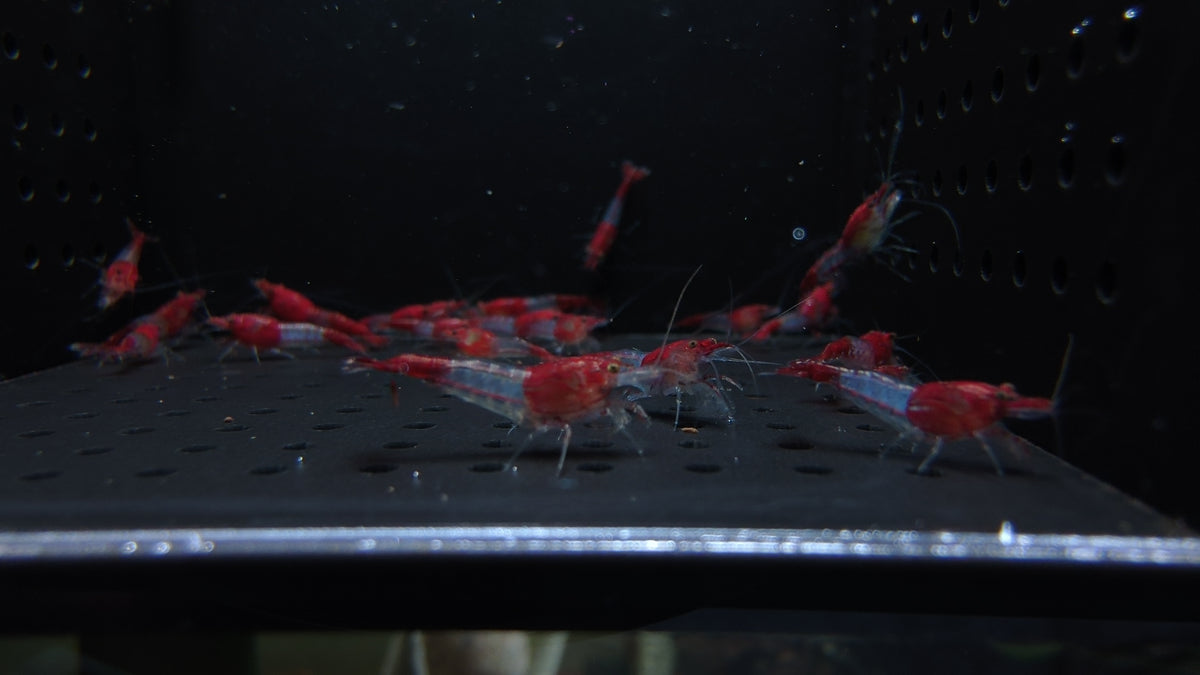
A red shrimp with a see-through middle — red head, clear body, red tail.
Arrives young. The three-part pattern is there from the start; the red deepens as they grow.
One price, no grades. Every one has the pattern, but the bands are never perfectly neat — that is the gene, not a fault, and sorting for tidy edges is what makes these expensive elsewhere.
Neocaridina — the easier of our two shrimp families, hardy and quick to breed, and a good first shrimp. Numbers in the FAQ.
The Rili pattern is a genetic trait, not faded colour: pigment is switched off through the middle of the body, leaving a coloured head and tail either side of a clear midsection. It breeds true. The Red Rili is that pattern in red. The Red Rili was stabilised around 2010 as a cherry-shrimp variant; ours is bred for a heavier, deeper red at the head and tail — closer to a Bloody Mary’s red than the thin, patchy red common on the mass market — so the break between red and clear reads sharper.
Like any cherry shrimp they are hardy, breed readily and forgive a beginner’s mistakes.
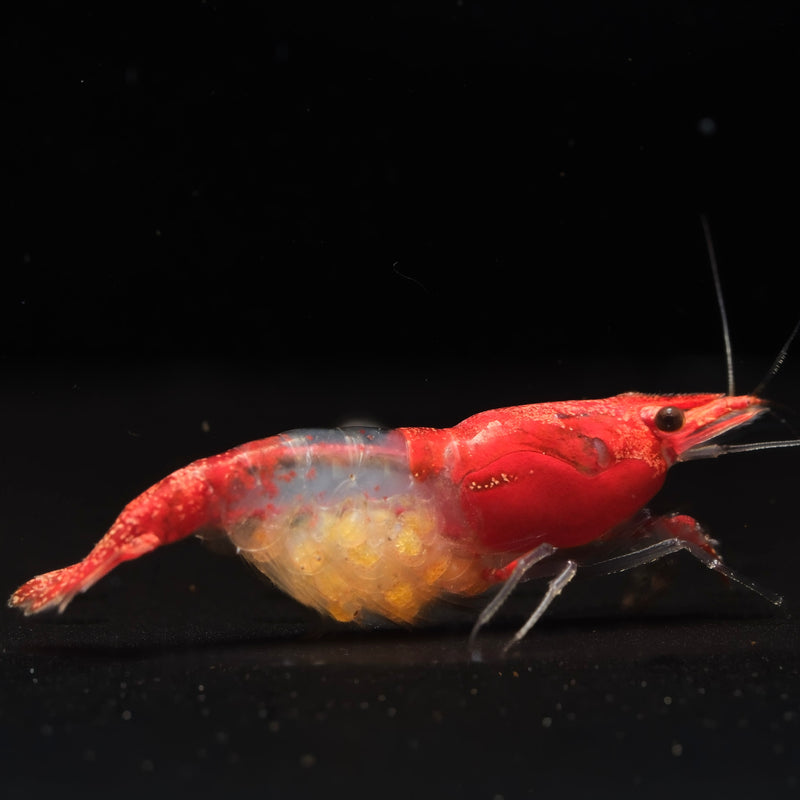
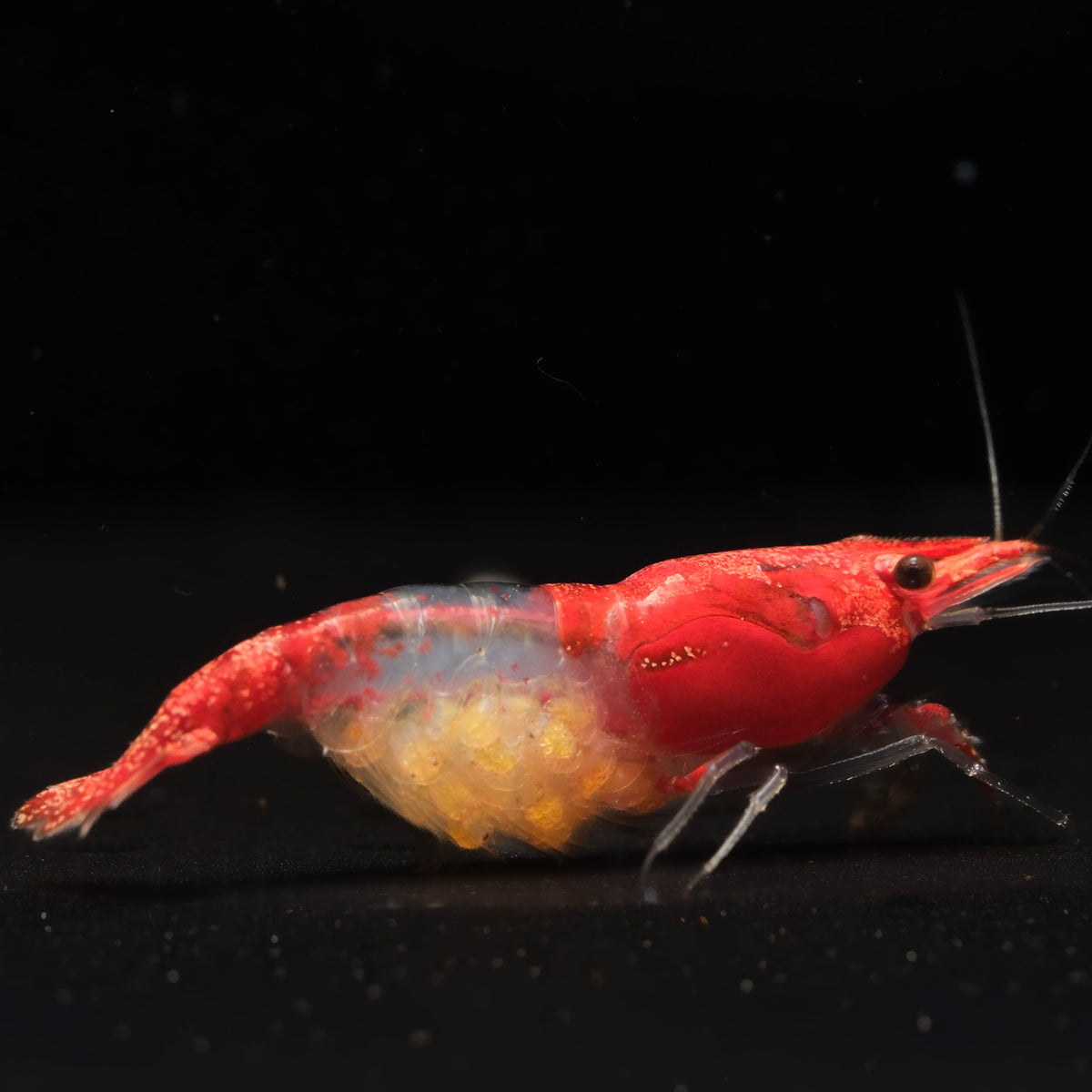
About the photo. The shrimp pictured is one of the best-looking adults from the batch. Juveniles arrive with the pattern set and the red lighter; the colour packs in and the break sharpens with each moult.
Honest expectations, before you buy:
- Our shipping standard: Every juvenile we ship shows the three-section pattern — red head, clear middle, red tail.
- The variation: The ratio and the edges will not be perfect. On some the clear section runs wider; on others the red bleeds into the middle, or the edges are jagged rather than straight. That is the gene, not a fault.
A visually “perfect” rili takes relentless culling, which is what drives the price up elsewhere. We would rather sell the whole colony honestly.
So Red Rilis are one grade, one price — robust unsexed juveniles, every one carrying the three-section rili genetics.
The photo shows a high-grade or best-looking adult from the batch. We ship unsexed juveniles, 0.6–1.2 cm — too young to tell male from female. Shrimp arrive pale from the trip and colour back up within days. For detailed water parameters, tank setup guides, and our 100% Live Arrival Guarantee, see our FAQ.
Guarantee & dispatch
Live arrivalClaim within 8 h
Claim within 8 hours of delivery with photos and a short video, ideally of the sealed bag. Your choice of a refund of the livestock value, free replacements, or store credit — all at no cost to you.
Mon & TueDispatch days
0.6–1.2 cmUnsexed juveniles
10+ of one lineColony starter
Unsexed juveniles at ten all but guarantee both sexes — about 1 in 500 odds of a single-sex group, against 1 in 8 at four — and a group settles faster than a pair. Our 10+ and 20+ prices are built around that. In a fully cycled tank held in their temperature band, fed lightly and left alone, expect the first berried females in around three months. How to get a colony going →
We don't ship live shrimp to WA, TAS or NT — message us for further enquiries: Messenger, Instagram or WhatsApp.
Full guarantee policy →Water parameters — Neocaridina
TDS
150 – 250 ppm
Total dissolved solids — the quickest single number to check. Ours is what they are raised in: match it on arrival, then keep it steady. Swings hurt more than the number itself.
GH
6 – 10 dGH
General hardness — the calcium and magnesium they build shells with. Too little and moults fail; too much and shedding gets hard.
KH
2 – 6 dKH
Carbonate hardness — the buffer that stops pH drifting between water changes.
pH
6.8 – 7.8
Set by your substrate and KH far more than by dosing. Hold it steady inside the band rather than chasing a number.
Temp
20 – 24 °C
Cooler slows moulting and breeding; warmer speeds everything up and shortens lives. Stay inside the band.
Tank
20+ L
The minimum for a settled colony. A bigger tank holds its water steadier, so we recommend larger groups in larger tanks — stability is what keeps shrimp alive.
Commonly kept 18–28 °C; breeding slows markedly below ~20 °C. Raised in remineralised Melbourne tap water.
Full care & acclimation guide →