24 September 2026
Cherry shrimp care in Australia
Cherry shrimp are the red colour form of Neocaridina davidi, a small freshwater shrimp. The same species comes in many other colours, from blue to yellow to black, and they all share one set of care needs. This guide covers those needs in plain terms, with the numbers we use for our own colonies in Victoria.
What a cherry shrimp is
Adults stay small, a few centimetres long. They spend the day grazing on biofilm, the thin film of microbes, algae and plant matter that grows on every surface in a tank. They are peaceful and they don't bother plants.
Like all shrimp, they grow by moulting: shedding the old shell and hardening a new, larger one. Most of good shrimp care comes down to making moulting easy, which means steady water with the right minerals in it.
We ship unsexed juveniles at 0.6–1.2 cm. "Unsexed" means too young to tell male from female; they sort themselves out as they grow.
The tank
- Cycle it first. Cycling means growing the helpful bacteria that turn fish and shrimp waste (ammonia) into less harmful forms. A cycled tank reads 0 ppm ammonia and 0 ppm nitrite. Shrimp are far more sensitive to water quality than fish. See How to cycle a tank for shrimp.
- Bigger is steadier. A larger volume of water changes temperature and chemistry more slowly than a small one, which is easier on shrimp.
- Gentle filtration. A sponge filter or a sponge over the filter intake stops baby shrimp being drawn in.
- Plants and moss. They give shrimp places to hide and more surface for biofilm. See The best plants for a shrimp tank.
Water parameters
A few terms first. pH is how acidic or alkaline the water is. GH (general hardness) is the calcium and magnesium in the water, which shrimp need to build each new shell. KH (carbonate hardness) is how strongly the water resists a change in pH. TDS (total dissolved solids) is everything dissolved in the water added together, read with an inexpensive pen.
These are our target ranges for Neocaridina davidi:
- Temperature: commonly kept 18–28 °C, with 20–24 °C the target. Breeding slows markedly below about 20 °C.
- pH: 6.8–7.8.
- GH: 6–10 dGH. Below about 4 dGH, failed moults are commonly reported.
- KH: 2–6 dKH. Keepers genuinely differ here: some run close to 0–1 dKH and others 3–6, and both work.
- TDS: 150–250 ppm.
- Ammonia and nitrite: 0 ppm, always.
- Nitrate: under 20 ppm. Small, regular water changes keep it there.
Steady beats perfect. Shrimp handle a reading slightly outside the range far better than one that keeps moving. The full detail is in Water parameters for Neocaridina.
Australian tap water
Tap water varies a great deal around Australia, and even between suburbs of the same city, so test yours rather than trusting a city average. As a broad picture, Melbourne, Sydney, Canberra, Hobart and Darwin supply soft water, while Brisbane, Adelaide and Perth run harder.
Our own tap in Melbourne's western suburbs measured GH 1, KH 3, pH 7.5 and TDS 50–70 ppm. The pH and KH are already in range for Neocaridina; the gap is GH. Soft tap water like this is short of the minerals shrimp need to moult. That is why we raise our Neocaridina in tap water with shrimp minerals added, taking it from a TDS of around 60 up to a target of around 160. A remineraliser is a powder that puts those minerals back.
Whatever your supply, treat tap water with a water conditioner to remove chlorine and chloramine (a longer-lasting form of chlorine) before it goes in the tank, and match its temperature to the tank.
Feeding
A tank with good biofilm feeds shrimp much of what they need. Add food sparingly, a little every day or two, and remove anything left after a few hours so it doesn't rot and foul the water. Overfeeding is one of the most common ways a shrimp tank goes wrong. See Feeding shrimp: what, how much, and how often.
Breeding
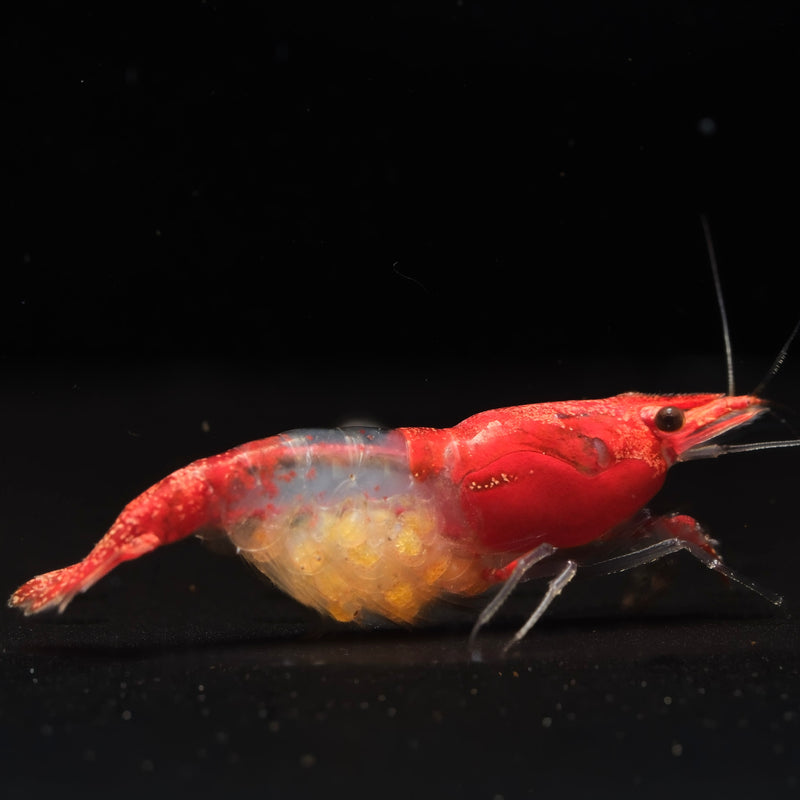
In steady water inside the ranges above, cherry shrimp breed readily. A female carrying eggs under her tail is called berried. The young hatch as tiny, fully formed shrimp and graze biofilm from the start. Temperature drives the pace: warmer water within the target range means faster growth and breeding, and breeding slows below about 20 °C. See Breeding Neocaridina: how to get a colony going, and for cooler months, Keeping shrimp through an Australian winter.
Common problems
- Failed moults. Often linked to low GH or sudden changes in water. See Shrimp moulting problems and the white ring of death.
- Copper. Shrimp need trace copper, but copper-based fish and snail medications are lethal to them at treatment strength. Check the label before adding any medication.
- Unexplained losses. Why are my shrimp dying? works through the usual causes.
- Pests. Planaria, hydra and Scutariella covers the common ones.
Bringing new shrimp home
New shrimp need to be eased into your water slowly rather than tipped straight in. How to acclimatise your new shrimp and our Care & Acclimation Guide walk you through it. When you're ready, browse our Neocaridina.
Cherry shrimp we breed
- Bloody Mary shrimp: deep, solid red cherry shrimp
- Blue Dream (Sapphire Blue) shrimp: solid deep-blue Neocaridina
- Green Emerald (Green Jade) shrimp: dark green Neocaridina
- Ultra Gold (Yellow Golden Back) shrimp: solid gold with a back stripe
- Red Rili shrimp: red head and tail, clear middle
- Demon Bloody Mary shrimp: orange-eye Bloody Mary
- Ghost Yellow (golden eye) shrimp: golden-eye Neocaridina
All come as unsexed juveniles with our live arrival guarantee.