10 August 2026
Tank mates: which fish are actually safe with dwarf shrimp

The honest answer to "what fish can I keep with my shrimp" is: fewer than most people hope, and the ones that work do so on mouth size, not temperament. Almost no freshwater fish is a specialist shrimp predator; almost every one is an opportunist, and a 2 mm shrimplet (baby shrimp) reads as food to all of them.
Adults and shrimplets are two different animals
An adult female Neocaridina davidi is around 2.5-3 cm, males 1.5-2 cm, and bee-type Caridina are similar — too big for most small community fish. Not universally safe, though: loaches, cichlids, gouramis and anything genuinely large-mouthed take full-grown shrimp, covered below.
Shrimplets are the whole story. Neocaridina and bee-type Caridina skip the free-swimming larval stage and leave the egg as roughly 2 mm miniatures of the adult, grazing in the open within hours. (Amano shrimp, Caridina multidentata, are the exception — their larvae need brackish (part-salt) water, so they almost never breed out in a home tank.) Shrimplets cannot outswim anything, and any fish with a gape (mouth opening) over about 2 mm — very nearly every community fish — will take them.
So the question is never "is this fish shrimp-safe" but whether the colony produces shrimplets faster than the fish removes them. Brood size and how often a female carries eggs are covered in breeding Neocaridina: how to start a colony. If fish take most of each brood, the colony holds at the number you bought, then shrinks as the originals age out — which is what "my shrimp stopped breeding" usually is.
We ship unsexed juveniles (young, not yet sexable) at 0.6–1.2 cm — bite-sized even for a fish that would ignore an adult. In a stocked community tank, grow them out separately first.
Where the common tank mates sit
| Fish | Adult size | Adult shrimp | Shrimplets |
|---|---|---|---|
| Otocinclus (Otocinclus spp.) | 4-5 cm | Safe | Low risk |
| Chili rasbora (Boraras brigittae) | 2 cm | Safe | Low risk |
| Pygmy corydoras (Corydoras pygmaeus) | 2.5-3 cm | Safe | Low to moderate |
| Neon tetra (Paracheirodon innesi) | 3.5-4 cm | Safe | High |
| Guppy (Poecilia reticulata), Endler's (P. wingei) | 3-6 cm | Safe | High |
| Betta (Betta splendens) | 6-7 cm | Depends on the individual | High |
| Dwarf chain loach (Ambastaia sidthimunki) | 5-6 cm | Not safe | Very few survive |
Genuinely low risk
Otocinclus are sucker-mouthed algae grazers with no mechanism for catching anything that moves — the closest thing to a free pass, though they need a mature, biofilm-rich tank (biofilm is the thin film of microbes that coats every wet surface) and are sensitive themselves. Their clean record rests on keeper observation rather than measured data, and they do scavenge dead shrimp, which is what most sightings amount to.
Chili rasboras and the other small Boraras hunt the water column (the open water) rather than picking through moss, which is where shrimplets sit. Whether the gape is genuinely too small for a new shrimplet, or just small enough that survival stays high, is not settled — treat it as reduced risk rather than none.
Pygmy corydoras sift substrate with small mouths, which is the exact ground shrimplets use. Opinion is genuinely divided: usually fine in a planted tank, occasionally not. The emerald dwarf rasbora is riskier again — despite the trade name it is a danio, Danio erythromicron.
Snails are effectively no risk — nerites, ramshorns and trumpet snails graze biofilm and scavenge; the one you find on a dead shrimp did not kill it.
Risky: fine with adults, bad for a colony
Most tetras. Neons, cardinals and rummynose are opportunistic micropredators that spend the day hunting shrimplet-sized things. Ember tetras (Hyphessobrycon amandae) get named as the safe exception on size alone: better than a neon, still a tetra.
Guppies, Endler's and other livebearers (fish that give birth to live young). They graze every surface including moss, and they breed, so predation pressure grows month by month on its own.
Bettas. Genuinely down to the individual. Some ignore adults for years; some hunt from day one. You cannot test for it in advance.
Flat no
Loaches. Botiid loaches, the dwarf chain loach included, hunt invertebrates and will work through a colony. How completely varies by species: the larger Botia and Chromobotia are the documented clearers, while the record on Ambastaia sidthimunki rests mostly on hobby accounts. Kuhli loaches (Pangio spp. — trade fish are commonly reported to be closer to P. semicincta than to true P. kuhlii, though shop identifications are rarely confirmed) are scavengers rather than hunters, but they work the substrate at night, where shrimplets are.
Cichlids, dwarfs included. Rams and Apistogramma are called peaceful because they are peaceful towards fish. They still pick shrimp off plants.
Gouramis. Anabantoids (the gourami family) hunt small invertebrates, and even sparkling gouramis (Trichopsis pumila) take shrimplets.
Anything large-mouthed — angelfish, larger barbs, goldfish, catfish over about 8 cm. If an adult shrimp fits, it is food.
The problems that are not predation
Temperature. Neocaridina are commonly kept anywhere from 18-28 °C, with 20-24 °C the sensible target, though those outer bounds are a hobby range rather than a measured tolerance; bee-type Caridina are less forgiving and want 20-24 °C. Many community fish are kept at 26-28 °C. Running warm for the fish speeds shrimp metabolism and is generally held to shorten lifespan — well established for ectotherms (cold-blooded animals) broadly, but poorly quantified for dwarf shrimp. The Caridina side is in water parameters for Caridina and Taiwan Bee shrimp.
Medication. Copper is a question of dose, not a substance to keep out of the tank altogether. Shrimp require it in trace amounts: it sits at the centre of haemocyanin, the copper-based protein that carries their oxygen, and it has a role in moulting, so it belongs in shrimp foods and trace-element fertilisers and is not worth stripping out of either. The hazard is a high dose. Copper-based fish and snail medications, and free copper measurable in the water column, are lethal to shrimp at levels that barely register on a fish. Read every ingredient list, and treat anything sold for external parasites as a problem until proven otherwise.
Feeding. Fish food ends up in the shrimp tank anyway, and the reflex when fish steal it is to add more. Wrong lever — amounts are in feeding shrimp: what, how much and how often.
Moulting. A freshly moulted shrimp is soft until the new shell hardens, and hides for that reason; how long the hardening takes is not well quantified for dwarf shrimp. Fish that ignore a hard-shelled adult will take a soft one — another argument for heavy cover, and for shrimp moulting problems and the white ring of death.
A species-only tank is the only way to grow a colony
If the goal is a colony that increases, the answer is a tank holding shrimp and snails and nothing else. Not a lightly stocked community tank, not a big tank where the fish have room. Predation does not scale down with volume; it just takes longer to notice.
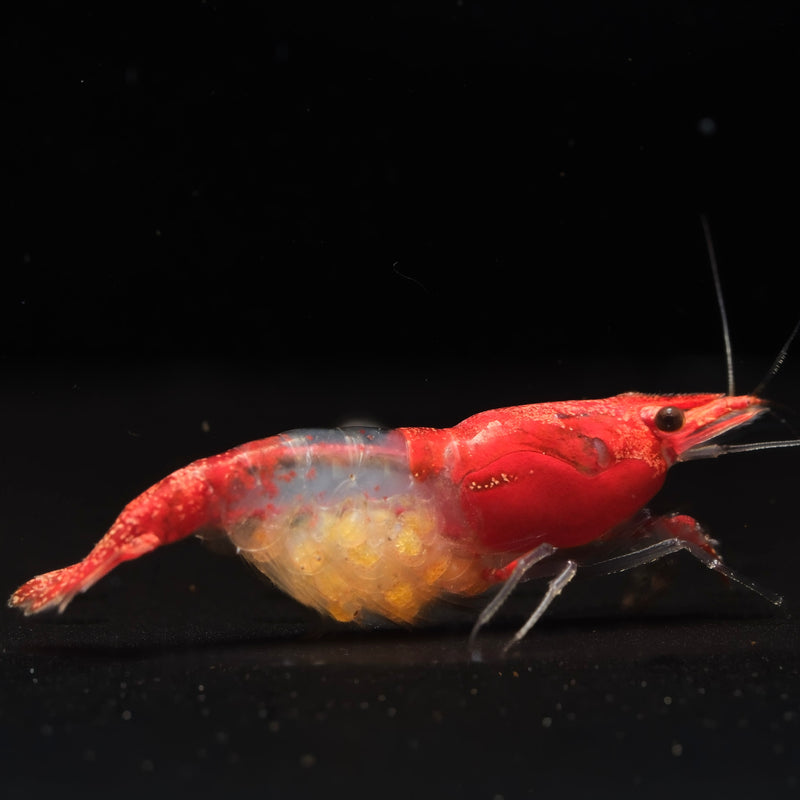
It also lets you see what you have: count berried females (females carrying eggs), spot a colour line drifting, cull (remove off-type animals) selectively. The setup need not be elaborate: sponge filter (a simple air-driven foam filter), a heater if the room runs cold in winter, dense java moss and leaf litter. Cover does the work, giving shrimplets somewhere to be while they outgrow most mouths; the best plants for a shrimp tank covers what else holds biofilm as well as moss does. Species-only is not hazard-free either — planaria, hydra and Scutariella arrive on plants and hardscape rather than on fish. If you want a planted display with fish anyway, pick from the low-risk list, add the fish months after the colony is established, and expect an ornamental population rather than a breeding project.
Two related points decide how many tanks you need. Neocaridina and Caridina do not interbreed, so keeping them apart is a water problem rather than a genetic one — see Neocaridina vs Caridina. Bee and tiger lines, though, do cross with each other — the hobby's Tibee and Taitibee lines are made by crossing them deliberately — so those want separate tanks unless a new line is the point. Mixing Neocaridina colour strains has the same answer for a different reason, covered in breeding Neocaridina: how to start a colony.
Our live arrival guarantee covers the animals as they arrive: a claim within 8 hours of delivery with photos and a short video of the animals in the unopened bag, then replacement or refund of the livestock value, your choice. It cannot cover what your fish do afterwards.