24 September 2026
Best beginner shrimp in Australia
If you've never kept shrimp, the choice can look bewildering: dozens of colours, names like Blue Dream and Crystal Red, and prices from a few dollars to a lot more. The good news is that the first decision is simple, and it isn't about colour at all. It's about water.
Three groups, three kinds of water
The dwarf shrimp sold in Australia fall into three groups. They look similar, and all of them graze quietly on algae and biofilm (the thin film of microbes that grows on every surface in a tank). But they want completely different water.
- Neocaridina: Cherry, Blue Dream, Snowball, Bloody Mary and many more. Hardy, forgiving of mistakes, and happy in ordinary treated tap water.
- Caridina: the "bee" shrimp, such as Crystal Red, Taiwan Bee and Galaxy Tiger. They need soft, slightly acidic water, which in practice means purified water with minerals added back, over a special substrate.
- Sulawesi: lake species such as Cardinal and Blue Leg Poso. They want hard, alkaline, warm water, the opposite of Caridina. The hardest of the three.
A tank set up for one group is not set up for another. So the real question for a beginner is which water you can keep steady, and for most people the answer is the water already coming out of the tap.
Why Neocaridina are the usual first shrimp
All Neocaridina colour lines are one species, Neocaridina davidi. Red, blue, yellow, black and the rest are colour forms bred from the same animal, so they share one set of care needs. Learn to keep one and you can keep them all.
They are the easier start for a few reasons:
- Tap water works. Treated tap water, with minerals added where it is very soft, sits close to what they need. Our own Neocaridina are raised in Melbourne tap water with shrimp minerals added, kept deliberately close to ordinary tap water so the move into a home tank is an easy step.
- Wider ranges. Neocaridina are commonly kept from 18 to 28 °C, with 20 to 24 °C the target, and a pH of 6.8 to 7.8. That leaves room for the small wobbles every new keeper makes.
- No special substrate. Substrate is the gravel or soil on the tank floor. Neocaridina don't need the special "active" substrate that Caridina tanks rely on.
- They breed readily. In steady water a small group becomes a colony, which is the most rewarding part of the hobby.
The water numbers, explained in plain terms, are in Water parameters for Neocaridina, and the day-to-day basics are in Cherry shrimp care in Australia.
Picking a colour line
Because the care is the same, choose the colour you like. A few things are worth knowing:
- Keep one colour per tank if you want it to stay that colour. Different Neocaridina colours interbreed, and mixed colonies tend to drift back towards dull, wild-type brown over generations. This is a well-known hobby observation.
- Young shrimp are paler. We ship unsexed juveniles (too young to tell male from female) at 0.6–1.2 cm, so colour is still developing, and every shrimp arrives pale from the trip and colours back up within days.
- Grades are about looks, not health. Where a line is graded, the grade describes appearance only. An Entry shrimp is the same lineage and hardiness as a higher grade. If you're new, starting at the accessible end is sensible. Our grading standard explains grades in full.
Browse the lines in our Neocaridina collection.
Why Caridina are a later step
Caridina such as Crystal shrimp, Taiwan Bee, Galaxy and Tiger lines are beautiful, and many keepers move on to them. They ask more of you:
- Different water. Our targets for Caridina are pH 5.5–6.5, GH 4–6 dGH, KH 0–1 dKH and TDS 100–150 ppm. GH is the calcium and magnesium shrimp need to moult (shed their shell to grow); KH is how strongly water resists a change in pH.
- RO water. That usually means starting from RO (reverse osmosis) water, which is water filtered back to almost nothing, and adding a GH-only remineraliser (a mineral powder) back in.
- Active substrate. A special substrate does the work of holding the pH low, and it wears out over time.
- Tap water rarely fits. Our own Melbourne tap measured GH 1, KH 3 and pH 7.5, which is wrong for Caridina on both counts: too few of the minerals they need, and too much of the buffering they don't.
None of that is hard once you're used to testing and adjusting water. It is just a lot to learn at the same time as learning shrimp. Keep Neocaridina first, and the habits you build carry straight over. Neocaridina vs Caridina: which should you start with? goes deeper, and Water parameters for Caridina and Taiwan Bee shrimp covers their water in full.
Before you buy any shrimp
- Cycle the tank. Cycling grows the helpful bacteria that break down waste, so ammonia and nitrite read zero. See How to cycle a tank for shrimp.
- Get a test kit and a TDS pen. Test your tap water. Water varies across Australia and between suburbs, so a city average won't tell you enough.
- Think about tank mates. Most fish will eat baby shrimp. Tank mates sets out how common fish behave around shrimp so you can decide.
- Plan for plants. Moss and plants give cover and grazing. See The best plants for a shrimp tank.
- Be home on delivery day. Live animals need to be received in person, and our Live Arrival Guarantee depends on it. Then acclimate slowly with How to acclimatise your new shrimp.
Start with one colour of Neocaridina, keep the water steady, and let the colony grow. Everything else in the hobby builds on that. See all our shrimp when you're ready.
Beginner shrimp we breed
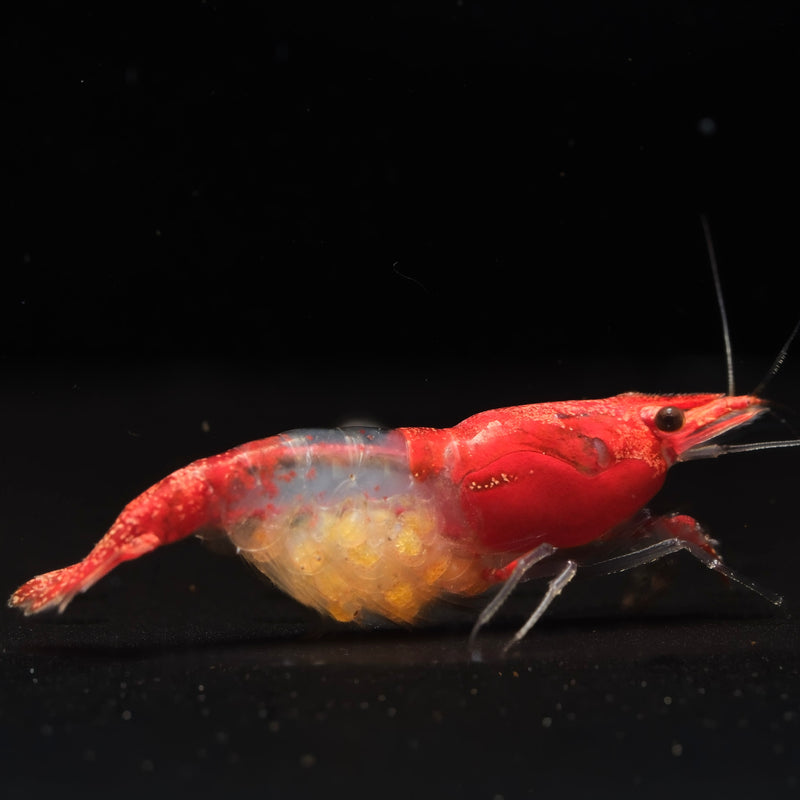
- Bloody Mary shrimp: deep, solid red cherry shrimp
- Blue Dream (Sapphire Blue) shrimp: solid deep-blue Neocaridina
- Green Emerald (Green Jade) shrimp: dark green Neocaridina
- Ultra Gold (Yellow Golden Back) shrimp: solid gold with a back stripe
- Red Rili shrimp: red head and tail, clear middle
All are Neocaridina, the easiest of the three groups above.